
Firmware engineered for reliable, connected EV charging
We develop embedded firmware for EV charging stations, connecting charging hardware, vehicle communication, device control, connectivity, and backend systems into reliable charging experiences.
Connecting every layer of the
charging experience
An EV charging station brings together power electronics, embedded control, vehicle communication, connectivity, and backend services. Firmware coordinates these systems to keep every charging session safe, connected, and predictable.
HIPTECH develops embedded firmware for charging infrastructure with a focus on hardware control, communication, device management, diagnostics, and system integration.
Firmware across the
EV charging architecture
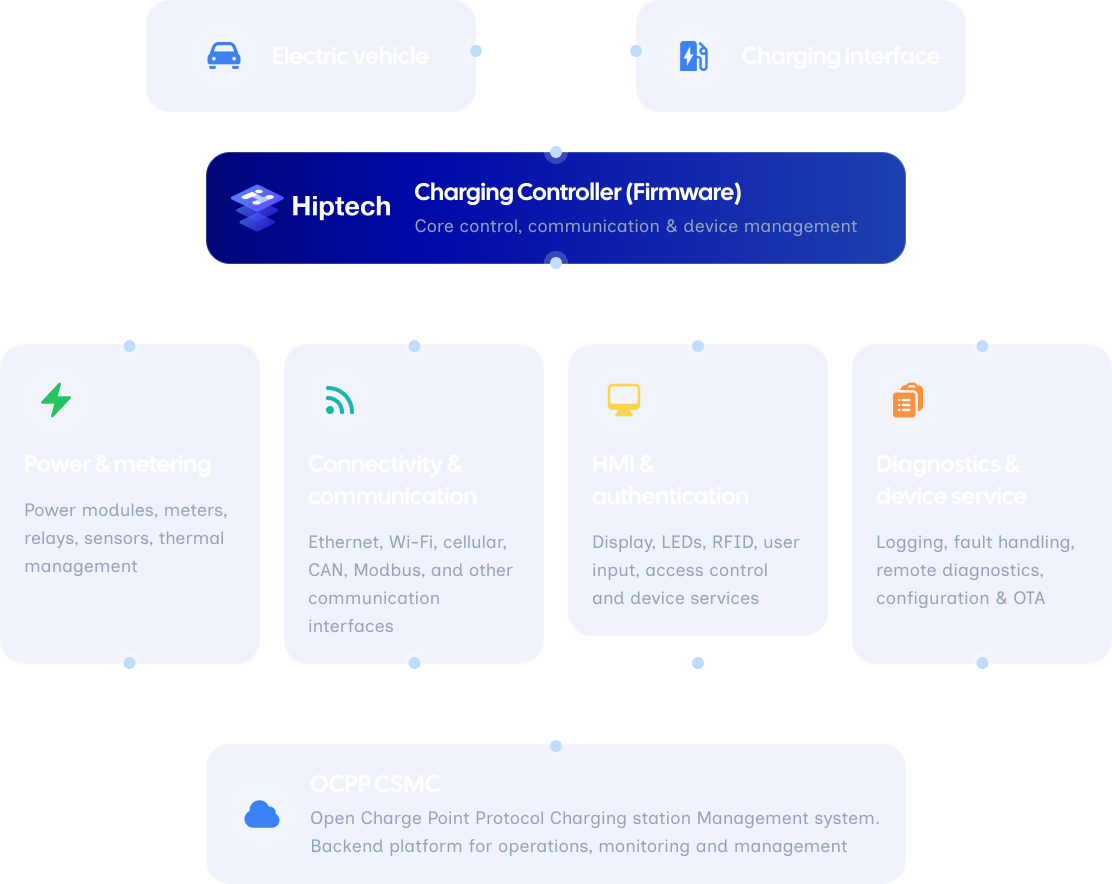
We develop firmware across the key components of connected charging stations, coordinating hardware control, communication, user interaction, and backend connectivity.
From embedded control to connected
charging infrastructure
We develop firmware across the core layers of EV charging systems, from low-level hardware control to communication, diagnostics, and backend integration.

MCU & embedded development
- Firmware for ARM Cortex M and embedded MCUs.
- Bare metal and RTOS development.
- HAL and peripheral driver development.

Charging control & hardware Interface
- Control of relays, sensors, meters, and power modules.
- Real time voltage, current, and temperature monitoring.
- Charging state and fault handling.

Communication & protocols
- Integration of CAN, PLC, Modbus, UART, SPI, and I²C.
- Developing ISO 15118-compliant digital communication between EVs and EVSEs to support Smart Charging and Vehicle-to-Grid (V2G) technology.
- Charging and backend protocol integration (OCPP 2.0 and 1.6)

Connectivity & backend integration
- Integration of Ethernet, WiFi, and cellular connectivity.
- Exchange of status, commands, and transaction data.
- Integration with charging management platforms.

Diagnostics & firmware management
- Diagnostics, event logging, and fault reporting.
- Bootloader, firmware update, and recovery.
- Remote configuration and device monitoring.

Reliability & system integration
- Integration across firmware, hardware, HMI, and backend systems.
- Fault detection and recovery.
- Stability testing and system debugging.
From charging requirements to
field-ready firmware
